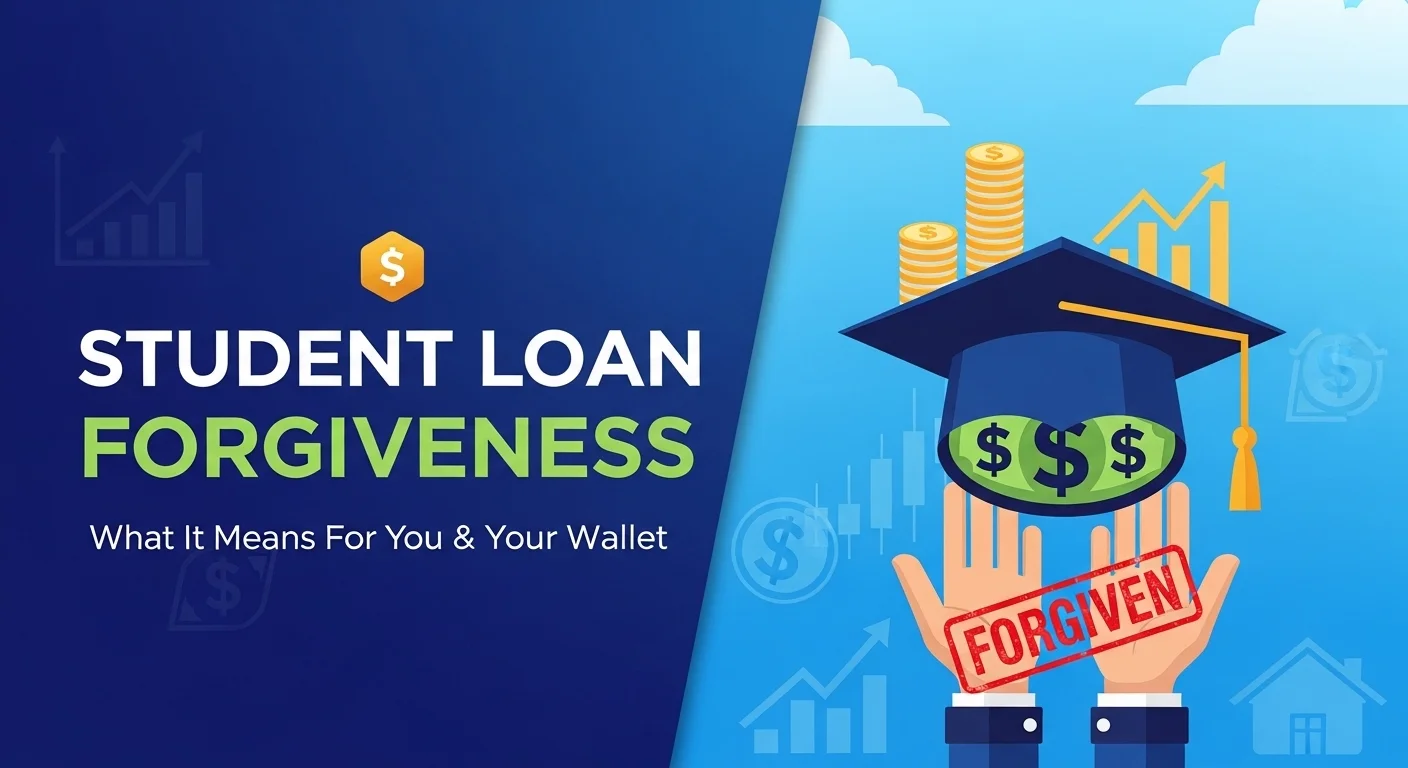
Student loan debt affects over 43 million Americans, with many borrowers owing tens of thousands of dollars. If you are struggling with student loan payments, loan forgiveness programs could eliminate part or all of your federal student debt. Understanding these programs and their requirements is essential for taking advantage of available debt relief opportunities.
This comprehensive guide covers all major student loan forgiveness programs available in 2026, including Public Service Loan Forgiveness (PSLF), teacher loan forgiveness, income-driven repayment forgiveness, and specialized discharge programs. You will learn eligibility requirements, application processes, and strategies to maximize your chances of approval.
What Is Student Loan Forgiveness?
Student loan forgiveness is the cancellation of some or all of your federal student loan debt. When loans are forgiven, you are no longer required to repay the forgiven amount. However, forgiveness only applies to federal student loans. Private loans do not qualify for federal forgiveness programs.
Different programs have specific eligibility requirements based on your career, repayment plan, loan type, or special circumstances. Some programs forgive loans after a certain number of qualifying payments, while others provide immediate discharge based on specific situations.
Public Service Loan Forgiveness (PSLF)
PSLF is the most well-known forgiveness program, designed for borrowers working in public service careers. The program forgives remaining federal Direct Loan balances after 120 qualifying monthly payments while working full-time for a qualifying employer.
PSLF Eligibility Requirements
Qualifying Employers:
- Federal, state, local, or tribal government organizations
- 501(c)(3) nonprofit organizations
- AmeriCorps or Peace Corps
- Other qualifying public service organizations
Qualifying Loans:
Only Direct Loans qualify. If you have FFEL or Perkins Loans, consolidate them into a Direct Consolidation Loan to become eligible.
Qualifying Payments:
- Made under income-driven repayment or 10-year Standard Repayment Plan
- Made while working full-time (30+ hours weekly) for qualifying employer
- Made on time (within 15 days of due date)
- Made for the full amount due
- Made after October 1, 2007
How to Apply for PSLF
Submit the PSLF Form (Employment Certification Form) annually and whenever you change employers to ensure your payments count. This form certifies your employment qualifies and tracks your progress toward 120 payments.
After making 120 qualifying payments, submit the PSLF Application for Forgiveness. The Department of Education reviews your employment and payment history. If approved, your remaining loan balance is forgiven tax-free.
PSLF Tips for Success
Track your qualifying payments regularly through StudentAid.gov. Do not wait until you have made 120 payments to submit your first employment certification. Submit annually to catch issues early. Keep detailed employment records and pay stubs as backup documentation.
Teacher Loan Forgiveness
The Teacher Loan Forgiveness program forgives up to $17,500 for teachers who work full-time in low-income schools for five consecutive years.
Eligibility Requirements
Teaching Requirements:
- Teach full-time for five complete and consecutive academic years
- Teach at low-income elementary or secondary school
- Began teaching after 1997-98 academic year
Forgiveness Amounts:
- $17,500 for highly qualified secondary math or science teachers
- $17,500 for special education teachers
- $5,000 for other eligible teachers
Important Limitations
You cannot receive both Teacher Loan Forgiveness and PSLF for the same period of teaching service. However, you can receive Teacher Loan Forgiveness first, then pursue PSLF afterward for additional qualifying employment.
Income-Driven Repayment (IDR) Forgiveness
Borrowers on income-driven repayment plans may receive forgiveness after 20 or 25 years of qualifying payments, depending on the specific plan.
IDR Plans Offering Forgiveness
- Income-Based Repayment (IBR): Forgiveness after 20 or 25 years
- Pay As You Earn (PAYE): Forgiveness after 20 years
- Revised Pay As You Earn (REPAYE): Forgiveness after 20 or 25 years
- Income-Contingent Repayment (ICR): Forgiveness after 25 years
Tax Implications
Currently, forgiven amounts under IDR plans may be considered taxable income, potentially creating a significant tax bill. However, the American Rescue Plan temporarily made forgiveness tax-free through 2025, and this provision may be extended.
IDR Forgiveness Strategy
Enroll in an IDR plan as early as possible to maximize your time toward forgiveness. Recertify your income annually on time to avoid delays. Keep detailed records of all payments in case you need to prove payment history.
Perkins Loan Cancellation
Federal Perkins Loans offer cancellation for specific professions serving high-need communities.
Qualifying Professions
- Teachers in low-income schools
- Nurses and medical technicians
- Law enforcement and corrections officers
- Firefighters
- Military service in hostile fire areas
- Public defenders and prosecutors
Specialized Discharge Programs
Borrower Defense to Repayment
If your school misled you or engaged in misconduct related to your loan or educational services, you may qualify for discharge. Submit a borrower defense claim with detailed evidence of the school misconduct.
Closed School Discharge
If your school closes while you are enrolled or within 120 days of your withdrawal, you may qualify for full loan discharge. Most eligible borrowers receive automatic discharge.
Total and Permanent Disability (TPD) Discharge
Borrowers who become totally and permanently disabled qualify for full loan discharge through Social Security disability determination, VA disability rating, or physician certification.
Death Discharge
Federal student loans are automatically discharged upon the borrower death. Parent PLUS Loans are discharged if either the parent or student dies.
How to Maximize Your Forgiveness Eligibility
Choose the Right Repayment Plan
For PSLF, enroll in an income-driven repayment plan to lower monthly payments while working toward forgiveness. Lower payments mean more debt remaining to be forgiven after 120 payments.
Consolidate Strategically
Consolidate non-Direct Loans into a Direct Consolidation Loan to make them eligible for PSLF. However, consolidation resets your payment count, so consolidate before making qualifying payments.
Track Everything
Keep detailed records of employment, payments, and correspondence. Use the PSLF Help Tool at StudentAid.gov to submit employment certification forms and track progress.
Common Mistakes to Avoid
- Not submitting employment certification forms annually
- Working for non-qualifying employers without verification
- Missing the 120-day closed school window
- Ignoring tax implications of IDR forgiveness
- Refinancing federal loans into private loans
Recent Changes and What to Know for 2026
The Biden administration broader student loan forgiveness plan faced legal challenges, but PSLF and other existing programs continue operating normally. Recent improvements to PSLF processing have made it easier to qualify, with over 790,000 borrowers receiving forgiveness as of early 2024.
The SAVE plan introduced in 2023 offers the most generous IDR terms yet. Stay updated on potential legislative changes, including possible extensions of tax-free forgiveness provisions.
Final Thoughts
Student loan forgiveness programs offer real opportunities to eliminate federal student debt, but they require careful planning and persistent tracking. Public Service Loan Forgiveness remains the most powerful option for those in qualifying careers, while income-driven repayment forgiveness provides a safety net for all federal borrowers.
Start by identifying which programs you qualify for based on your career, loan types, and circumstances. Submit required forms on time, track your progress regularly, and maintain detailed records. If you work in public service, submit PSLF employment certification forms annually.
Federal student loan forgiveness is not automatic, but it is achievable. Take action today by reviewing your eligibility, organizing your documentation, and submitting necessary forms. Your path to student loan freedom starts now.
________________________________________________________________________________
Disclaimer: This article provides educational information only and does not constitute legal or financial advice. Student loan forgiveness programs, eligibility requirements, and tax implications are subject to change based on federal legislation and Department of Education policies. Always verify current information at StudentAid.gov and consult with your loan servicer or qualified financial advisor. This content is not endorsed by or affiliated with the U.S. Department of Education.